- Jun 10
Trusting the Process: Trade Off Analysis and Deciding
- chi decisions
- 0 comments
I was recently watching the Netflix series The Witness, and a glaring investigative failure stood out. The police homed in on Colin Stagg as their only suspect early on and simply stopped looking at anyone else. From that moment, any evidence pointing to the contrary was treated as an inconvenience rather than a clue.
The exact same trap exists in strategic decision-making. If there was ever a time to trust the process, it is the trade-off step. This is the stage closest to the final commitment, which is exactly why the temptation to rush it is strongest. That temptation is to lock in your preferred 'suspect' and ignore the rest.
But shortcutting here squanders all the good work you have already done in framing, identifying alternatives, and analysing each alternative under uncertainty. It is also where teams quietly revert to old habits: advocating for a favourite, anchoring on an early number, or deferring to the most senior voice in the room.
Feature Article: Conduct Trade-off Analysis and Decide
This month our featured article explores the fifth part of the SABUDI framework. We expected this to be one of our shorter articles, but it ended up being our longest to date. We cover a lot of ground on exactly how to systematically compare your alternatives and make a defensible choice.
Key areas we cover include:
The cost of rushing. The four traps teams fall into when skipping the trade-off step, including single-criterion tunnel vision and hidden trade-offs.
Comparing full distributions. Why we compare alternatives using cumulative distribution functions (CDFs) rather than single-point averages to get the full picture of the risk.
Stochastic dominance. How to use dominance as a first screen to set aside inferior options immediately.
Honest swing weighting. Why multi-criteria weights must reflect the actual swing between worst and best outcomes, rather than just how important a criterion sounds.
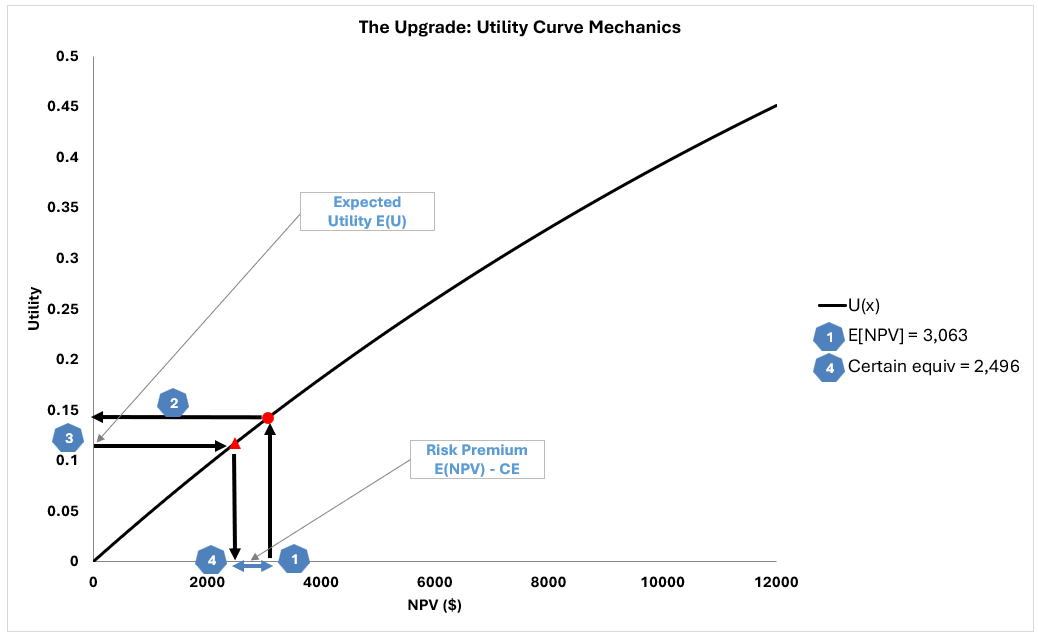
The certain equivalent. How expected utility theory lets you collapse a messy distribution into a single, honest, risk-adjusted figure to rank your options. Sometimes referred to as 'certainty equivalent'. The figure below illustrates this.
-
The Sentinel Mindset. How to guard against biases that spike at the point of choice, including defensive decision-making and the manager’s bias.
All of this serves one purpose: a decision you can stand behind the moment you make it, before the outcome is known. That is what a good decision is, one you can explain and defend on its merits rather than on how it happened to turn out. You can read the full article here - Trade Off Analysis and Deciding.
Catch Up on the SABUDI Series
If you missed the earlier steps in the framework, you can access the foundational articles here:
· Mastering Decision Framing for Strategic Clarity (free)
· Creative Alternative Identification in Decision Making
· Alternative Analysis Accounting for Uncertainty
Upcoming Training & Updates
Final Training Session
Our last training session for the current financial year is on Tuesday, 30 June 2026. Sign-ups close on Tuesday, 16 June, at 5:00 pm AEST. Register here – Training Sessions.
The Risk Minute
For those following our quick-fire insights, The Risk Minute is still scheduled to restart its regular publication cycle in July 2026.
A Special Sneak Peek
Finally, we are close to finalising a new tool designed to support structured decision-making in all walks of life. Whether you are an executive, an entrepreneur, a leader, a parent, or a student, it is built to bring clarity to your choices – a prism you can hold any decision up to and quickly run through. We will reveal the details in our next newsletter before the end of the month.
That is your lot for the month. Next time you reach the point of naming a single winner, pause before you commit and ask yourself: have I made the trade-off explicit, or am I about to decide on instinct? Trust the process – it is the work you have already done that makes the final call defensible.
Cheers,
Arthur
P.S. Not yet subscribed? Make sure you don’t miss future issues: Subscribe here. Access all our previous newsletters here – chi decisions Newsletters.