- May 11
Analysing Alternatives Accounting for Uncertainty
- chi decisions
- 0 comments
This month our feature article explores the fourth step of the SABUDI decision framework, focusing on how to analyse a carefully selected set of alternatives while properly accounting for uncertainty. The article walks through the process of building out each alternative so we can determine its potential value, starting from a single-point estimate as the baseline. From there, it shows how to identify the drivers that matter most to that value outcome through sensitivity analysis, separating the noise from what actually moves the needle.
Finally, it demonstrates how to characterise uncertainty across those key drivers and use probabilistic simulation to generate a full range of potential outcomes rather than a single answer.
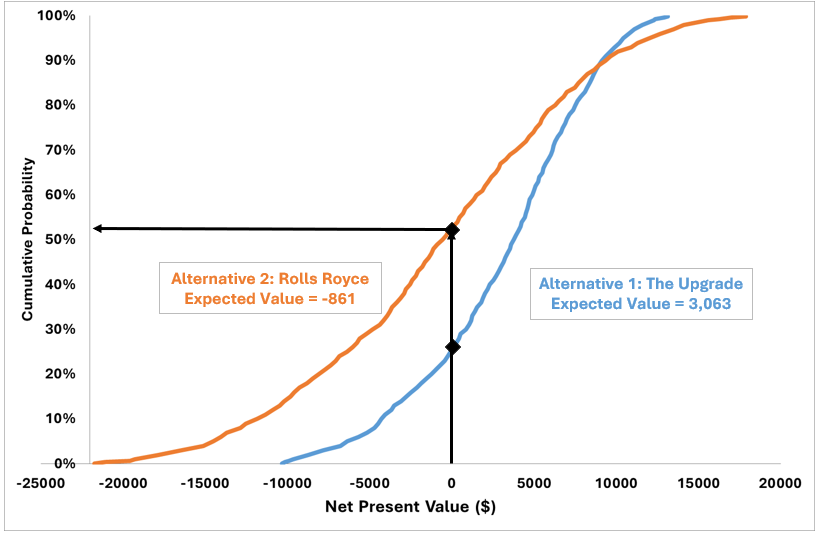
The result is a clearer, more defensible picture of how the alternatives compare, including the probability of each meeting your value target. If you've ever wanted to move beyond gut feel and single-point estimates when comparing strategic options, this article gives you a practical process to do exactly that.
Check out the full paid article here - Alternative Analysis Accounting for Uncertainty.
Training Calendar for 2026
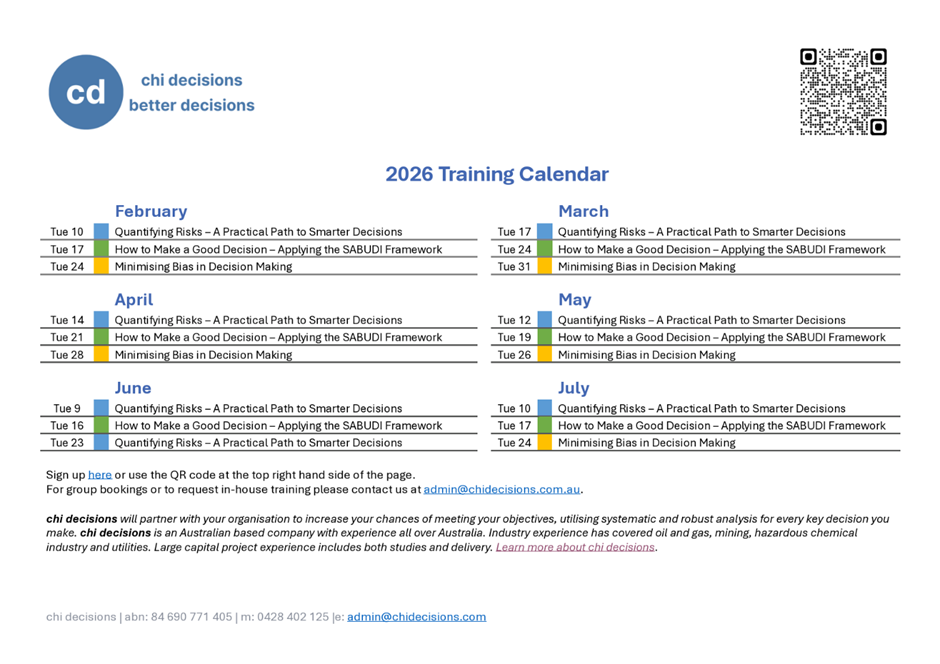
It is shaping up to be a busy end of financial year, with high-quality risk and decision-making training on offer. Sign up via the QR code below or through this link - Training Bookings. Full details are in the training calendar below.
Free Resources
Check out our free articles here - Articles.
Some of our most popular resources include:
Free Template - Good Decision Making using SABUDI Decision Framework
PowerPoint - Good Decision Making using SABUDI Decision Framework
The Risk Minute
The Risk Minute will resume in the new financial year. If you haven't seen the first two episodes yet, check them out below.
https://www.youtube.com/watch?v=ho25U1YeR1A
https://www.youtube.com/watch?v=FDxE-5iXbZo
Looking Ahead
Our upcoming feature article will focus on the D step of SABUDI: conducting trade-off analysis and deciding on an alternative. We look forward to sharing practical tools to help you run a fit-for-purpose trade-off analysis that gives your decision maker what they need to make an informed call.
That is your lot for the month. Next time when you have your four to six alternatives in front of you, ask yourself: what is the simplest form of analysis that lets me compare these meaningfully? That answer will tell you exactly how deep to go. Time is money, and in most cases the simplest approach that is fit for purpose is the right one.
Cheers,
Arthur
P.S. Not yet subscribed? Make sure you don't miss future issues: Subscribe here.
Access all our previous newsletters here - Chi Decisions Newsletters.