- Jul 6
Turning a Decision into Lasting Learning: Implement and Iterate
- chi decisions
- Decision Making Under Uncertainty, Chi Decision Cards
- 0 comments
In a previous role, our tank alarm design procedures drew on API 2350, the foundational industry standard for overfill prevention, among other standards and internal requirements. That standard was not static. It was revised as the industry learned, often from disaster. One such disaster was CAPECO, where a storage tank at the Caribbean Petroleum facility in Puerto Rico was overfilled during a routine ship transfer. Gasoline poured from the vents, formed a vast vapour cloud, and ignited. The fires burned for days. When CAPECO and events like it fed into a revision of API 2350, we updated our own procedures to match. The next person filling a tank inherited the lesson instead of repeating it.
That is exactly what the final step of SABUDI is about. A decision is made, it is implemented, reality tests its assumptions, and the lesson is fed back so the next decision is better. Implementation is where assumptions meet reality. They prove wrong, unexpected events occur, and new information surfaces that no one had when the decision was made. Captured and acted upon, these become learnings that improves the next decision. Left to evaporate, they teach nothing. This is also where old habits creep back. Hindsight bias whispers 'I knew it all along'. Resulting judges the decision by how it happened to turn out rather than by the process that produced it. Both quietly erode the discipline that improves your odds.
Feature Article: Implement and Iterate
This month's featured article explores the sixth and final part of the SABUDI framework. It is where analysis meets reality, the chosen alternative is put into practice, and the lessons are captured so the next decision is better than the last.
Key areas we cover include:
Implementation starts after approval: Approval is the point at which analysis becomes a real commitment of resources, whether that means starting work next week or passing a phase gate. Implementation itself usually follows the organisation's existing project management processes, covering planning, execution, monitoring and reporting. We look at why the frame has to travel with the project through those stages into delivery.
Iteration improves the decision: How pilots and staged rollouts test assumptions in practice while exposure is still small, and why iteration is not a licence to relitigate a sound decision every time new information arrives.
Learning embedded in the process: How lessons learned activities, benchmarking and reporting turn one team's experience into organisational knowledge that survives the people who were there.
The three reports: The Decision Approval Report, the Decision Implementation Report and the Post-Implementation Review Report, and why the timing of each one matters as much as its content.
Documenting assumptions: Why the assumptions register is the single most important artefact for learning, because it records what the team believed at the moment the decision was made.
The Sentinel Mindset: How the whole framework, not any single step, is the antidote to resulting and its forward-looking cousin, defensive decision making.
We also return to our worked example one year on for a post-project review and see what the decision actually taught the business once more data was available.
All of this serves one purpose. A decision you can stand behind on its merits, and an organisation that gets a little better at deciding every time it decides. You can read the full article here, Implement and Iterate.
Catch Up on the SABUDI Series
If you missed the earlier steps in the framework, you can access them here:
Mastering Decision Framing for Strategic Clarity (free)
Creative Alternative Identification in Decision Making
Alternative Analysis Accounting for Uncertainty
Trade Off Analysis and Deciding
Introducing the Chi Decision Cards
The tool we teased last month is here. The chi decisions Decision Cards are a physical deck that prompts you with the right questions at every stage of the SABUDI process, whatever decision you are making. Hold any decision up to the deck and run through it.
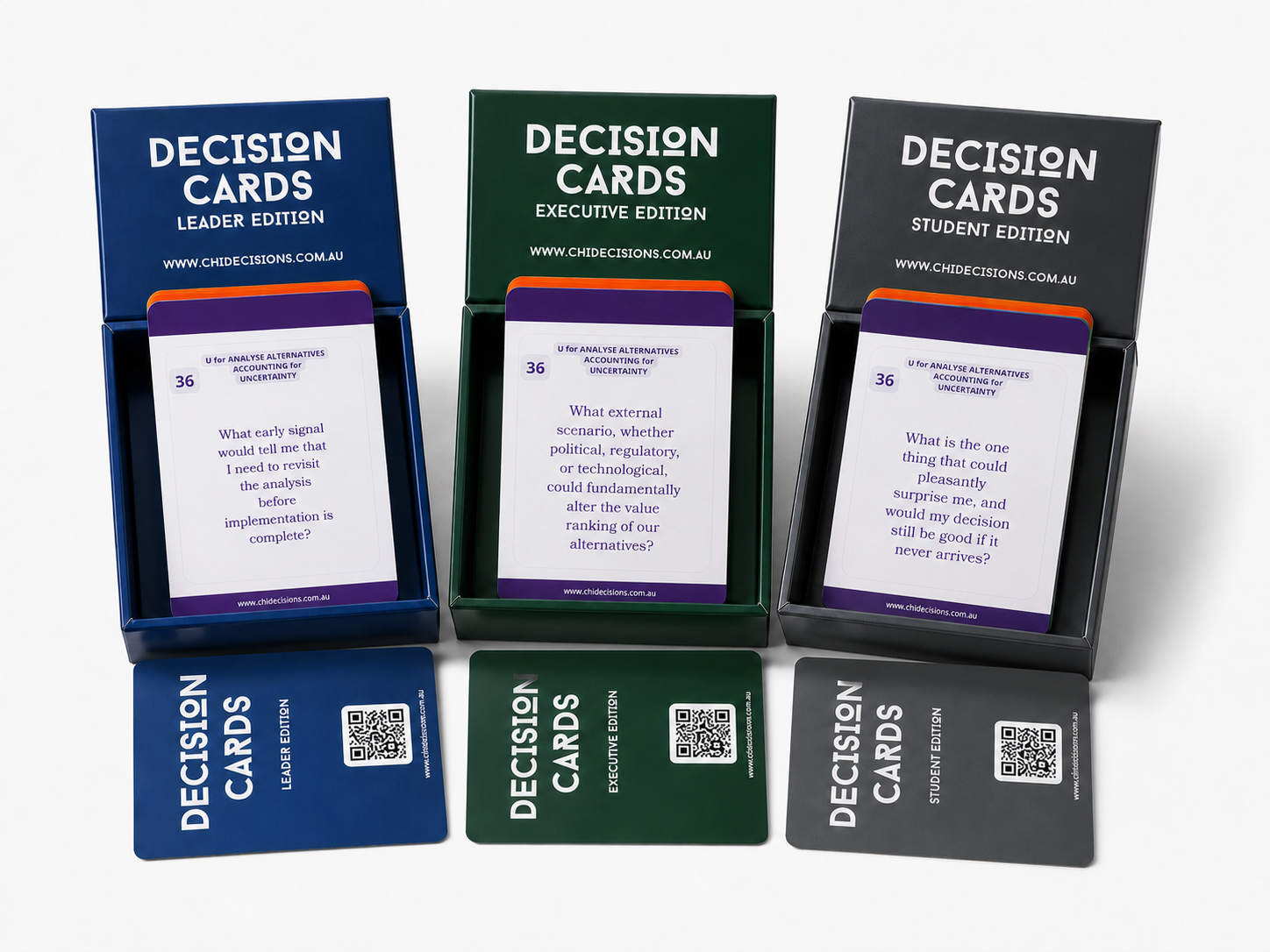
The Leader Edition is available to order now. The Executive Edition and Student Edition ship from 1 August 2026. Order here: https://chi-decisions.myshopify.com/products/classes-example-product-4?variant=45251888185453.
To help you get the most from your Chi Decision Cards, we publish weekly videos demonstrating how selected cards can be used at different stages of the decision-making process. New episodes drop weekly on our socials chi decisions (@chidecisions) / X and Facebook.
Coaching and Training
Our training calendar for the new financial year will be issued in the August newsletter. In the meantime, you can sign up for one-on-one coaching any time here: Risk or Decision Analysis Coaching Sessions (3 sessions).
The Risk Minute
After conducting some trade off analysis on our own, we have decided to pause The Risk Minute for now. It may resume in January 2027.
That is your lot for the month. Next time you sign off on a decision, resist the urge to quickly file it and move on. Write down what you assumed, implement in a way that lets you learn, and come back to check. Trust the process. It is what turns a single decision into a better next one.
Cheers,
Arthur
P.S. Not yet subscribed? Make sure you don't miss future issues: Subscribe here. Access all our previous newsletters here: chi decisions Newsletters.