- Aug 4
Producing Trustworthy Inputs
- chi decisions
- Decision Making Under Uncertainty
- 0 comments
In October 1983, Air Illinois Flight 710 took off from Springfield into a night sky over rural Illinois. Minutes after departure, both generators dropped offline. The left one had genuinely failed. The right one was working fine. The right generator had a recent history of maintenance trouble, so when the warnings appeared, the crew expected it to be the culprit and moved to isolate it, without checking the gauges that would have told them the left one was the real problem. They isolated the healthy generator. That left the aircraft on battery power alone, roughly thirty minutes of instruments and lights, on a flight that needed thirty-nine minutes to reach Carbondale against six minutes to turn back. The captain pressed on. The batteries ran down, the instruments went dark, and the aircraft crashed near Pinckneyville. All ten people on board were killed.
Investigators called one of the contributors: expectation bias. The crew acted on the diagnosis they expected rather than the one the instruments actually supported. The failure was not a lack of information. The information was right there on the panel. It was that a prior belief overrode what the data was saying.
This is the trap at the heart of this month's article. A model does not question the numbers it is given. It takes whatever estimates you feed it and turns them into an NPV distribution that looks objective, whether or not the inputs behind it were honest. A bias that reaches the inputs becomes a number the analysis then trusts.
Feature Article: Producing Trustworthy Inputs
This month's featured article is the final piece in the SABUDI series, and it tackles the discipline that sits beneath every model in the series, sourcing the numbers you can actually trust.
Key areas we cover include:
Not every input deserves the same effort: How sensitivity analysis and the tornado chart tell you where the uncertainty actually lives, so you spend your effort on the inputs that move the result and take the rest straight off the record.
Three kinds of input: Measured quantities, estimated quantities and choices, and why each is sourced in a different way.
Forecasting from the outside view: Why the most accurate forecasters start from the base rate and adjust, rather than building up from the vivid particulars of the case in front of them.
Elicitation done properly: The structured interview that turns expert judgement into an honest distribution, including the clairvoyant test, encoding from the extremes inward, and the equivalent bet test explained in plain terms.
Calibration you can train: Why calibration is a skill, not a fixed trait, and how keeping score keeps experts honest.
Combining experts: How to combine independent judgements so you capture more information than any one expert holds, without averaging away an honest disagreement.
We also close the loop with the whole framework, showing how each SABUDI step is built to neutralise a specific bias, and how the assumptions register lets the Post-Implementation Review ask, one assumption at a time, whether the inputs were honest. You can read the full paid article here, Producing Trustworthy Inputs.
The SABUDI Series is Complete
With this article, the six-part SABUDI series is finished. If you missed any of the earlier steps, you can catch up here:
All Three Decision Card Editions Are Here
The wait is over. All three editions of the chi decisions Decision Cards are now available. Each is a 54-card deck built on the SABUDI method, prompting you with the right questions at every stage. Hold any decision up to the deck and run through it.
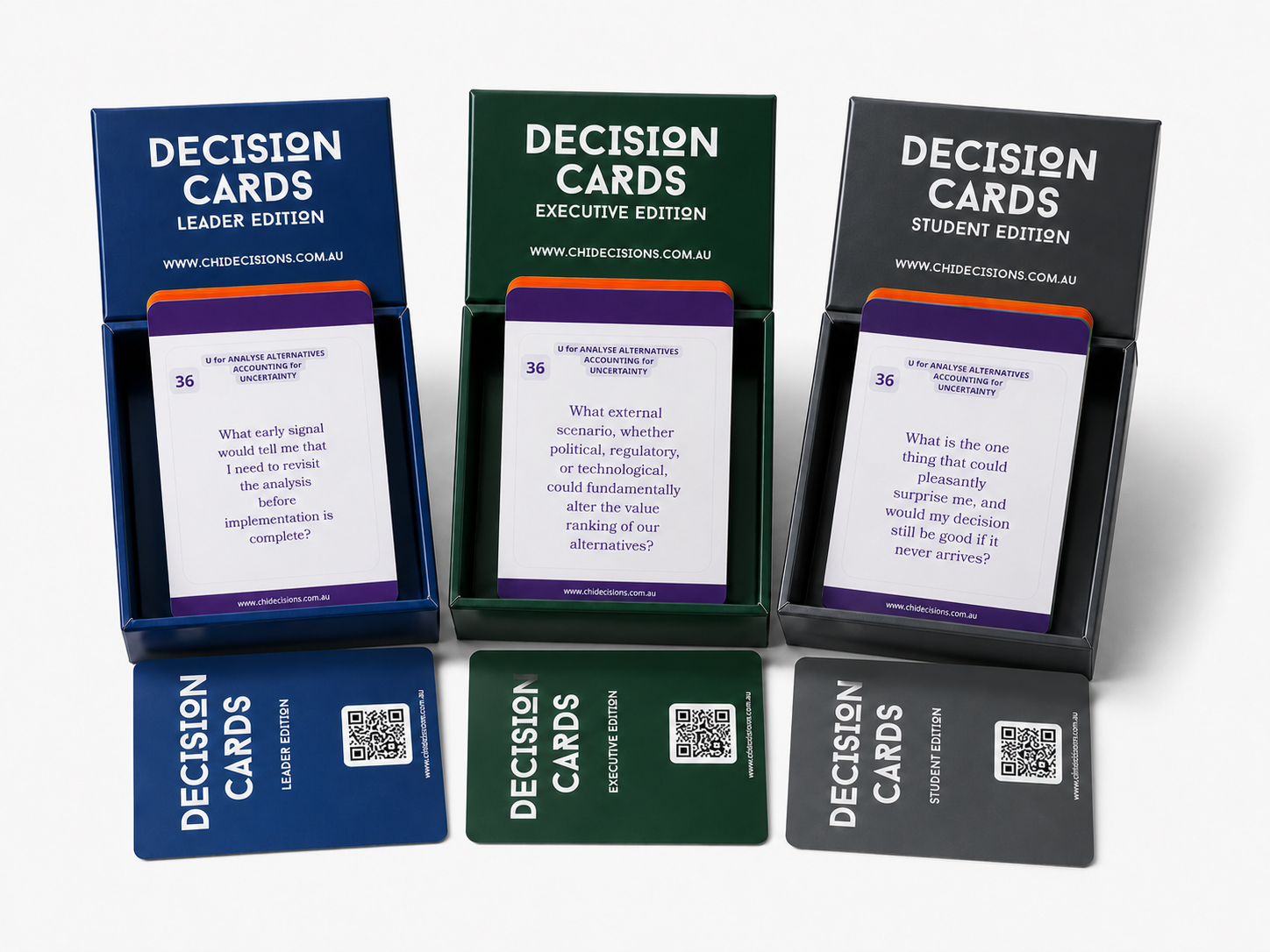
Leader Edition (AU$29.99): For general managers, project leaders and emerging leaders who need a repeatable process for high-stakes calls. Premium 350gsm cardstock in a rigid telescope box.
Executive Edition (AU$34.99): For CEOs, CFOs, CROs and other executives who need to frame, interrogate and govern the biggest decisions. Same premium build, pitched at the C-suite.
Student Edition (AU$24.99): For students who want a simple, proven process for better decisions at school, at home and in life.
Order any edition here: https://www.chidecisions.com.au/products
Buying for a team?
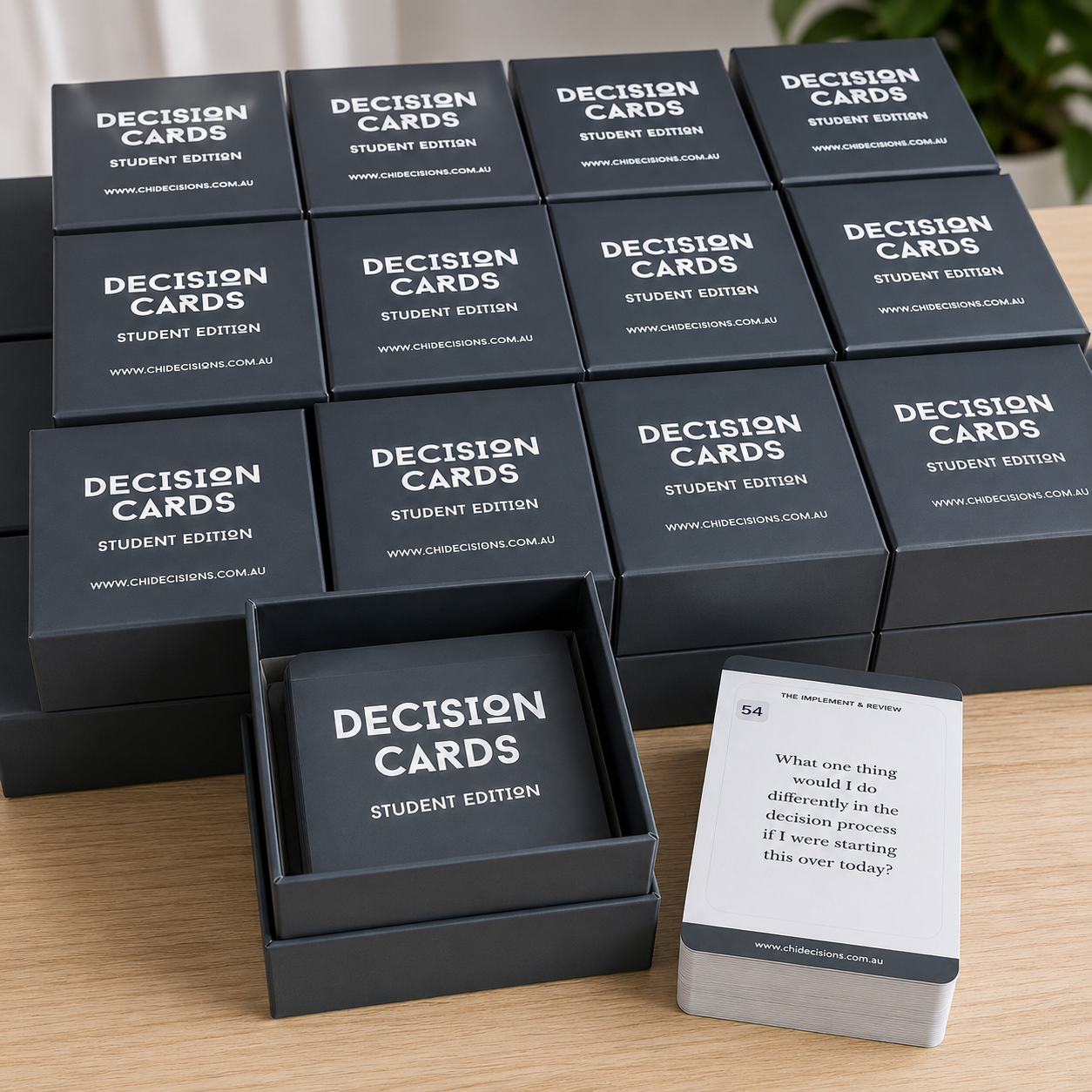
Bulk orders are available across all three editions. The Student Edition is best for schools, colleges, universities, careers programs and student leadership development, with volume discounts available. Kit out your leadership group, your project team or a whole student cohort. Enquire here: https://www.chidecisions.com.au/bulkorders
New: The Guided Decision Workbook
If you prefer to work through a decision on paper, we have released the Guided Workbook, How to Make a Good Decision (AU$12.99).
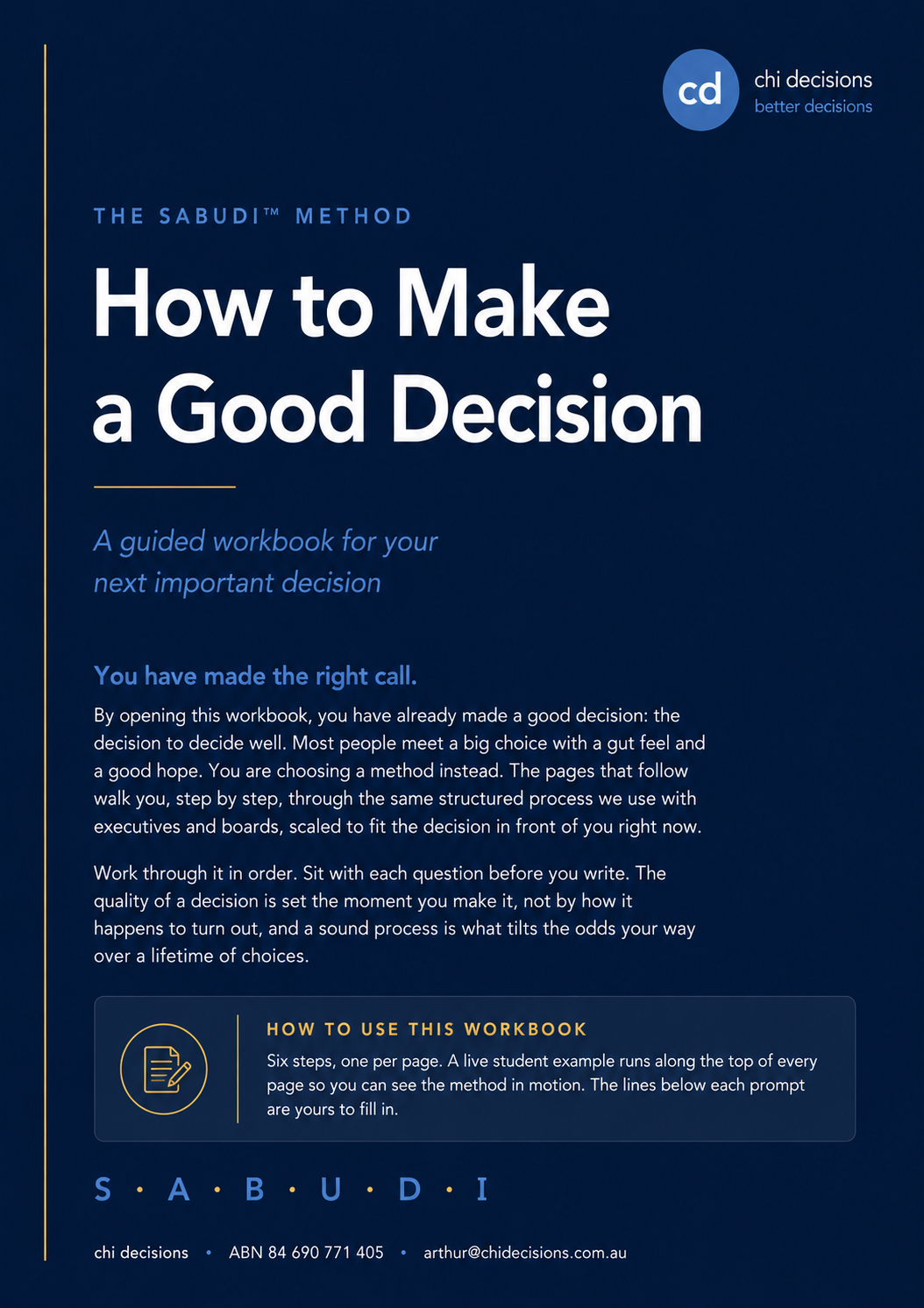
It is a fillable A5 PDF that walks you step by step through the SABUDI method for your next big choice, with one worked example threaded from start to finish and space for your own answers at every step. Buy once, use for every decision that matters. Order here: https://www.chidecisions.com.au/products
See the Cards in Action
We have been publishing videos on LinkedIn exploring how individual cards work at different stages of the process, and it has been great to see how many of you are enjoying them. Here are a couple to get you started:
Follow along on LinkedIn page for the rest.
TikTok for Students
For the younger decision-makers, and the Student Edition, we are also on TikTok. Send this to a student in your life: https://www.tiktok.com/@chidecisions
Coaching and Training
To reserve training please jump onto our website to view our current option - Training - Quantifying Risks for Better Decision Making.
In the meantime, you can sign up for one-on-one coaching any time here: Risk or Decision Analysis Coaching Sessions (3 sessions).
That is your lot for the month. Next time a number lands in front of you, resist the pull of that first figure. Ask how it was derived, what evidence sits behind it, and whether it should be a range rather than a single point..
Cheers,
Arthur
P.S. Not yet subscribed? Make sure you don't miss future issues: Subscribe here. Access all our previous newsletters here: chi decisions Newsletters.