- Sep 8
Choosing Wisely in the Age of AI
- chi decisions
- Decision Making Under Uncertainty, Chi Decision Cards
- 0 comments
On 3 November 1914, around 8,000 British and Indian troops began landing near the East African port of Tanga. Their mission looked straightforward. Capture the port, defeat a much smaller German force and move on. Major General Arthur Aitken was in command. On the other side was Lieutenant Colonel Paul von Lettow-Vorbeck, commanding the German forces defending German East Africa. The British had the overwhelming advantage in numbers and firepower. They also had a naval cruiser sitting offshore. It should have been an easy decision. It wasn't.
The British had been told the harbour was mined, so they landed several kilometres south of Tanga. They then advanced without proper reconnaissance through difficult bush and plantations. Lettow-Vorbeck had already been warned that an attack was coming and was able to reinforce the town. As the British advance met German machine-gun fire, the fighting became confused and fragmented. Then, in one of the more bizarre episodes of the battle, gunfire disturbed beehives and swarms of angry bees attacked both sides. The engagement became known as the Battle of the Bees. The British eventually withdrew, having suffered close to 850 casualties against barely 150 on the German side.
The interesting part isn't the bees. The British did not lose because they lacked capability. They had more people, more equipment and more firepower. They lost because the decision was built around assumptions that were not adequately tested, the situation was not properly understood and the force did not do enough to challenge its own view of what was about to happen. More capability does not automatically produce better decisions.
And that is an interesting place to start when we think about AI. We now have more decision-making capability available to us than ever before. But does having more capability actually help us make better decisions?
Feature Article: Choosing Wisely in the Age of AI
AI has changed what organisations can do when making strategic decisions. It can analyse vast amounts of information, generate alternatives, challenge our thinking, model uncertainty and increasingly take on work that people used to do themselves. But has AI actually changed what makes a good decision? Our new article, Choosing Wisely in the Age of AI, explores that question through a much more fundamental lens: what happens when a powerful new decision-making capability meets a sound decision process?
There are some uncomfortable questions along the way. Can AI make a bad decision frame look convincing? When does more analysis actually make a decision worse? What happens when we let AI recommend the answer? And if an AI agent can do the work, should it? One of the article's central observations is simple, that AI gives us more ways to do the work. The difficult part is knowing which of those ways genuinely improve the decision. Choosing wisely means deciding what AI should do, what it shouldn't do, and what still needs us.
Read the full article here.
Executive Edition: The card that changed the conversation
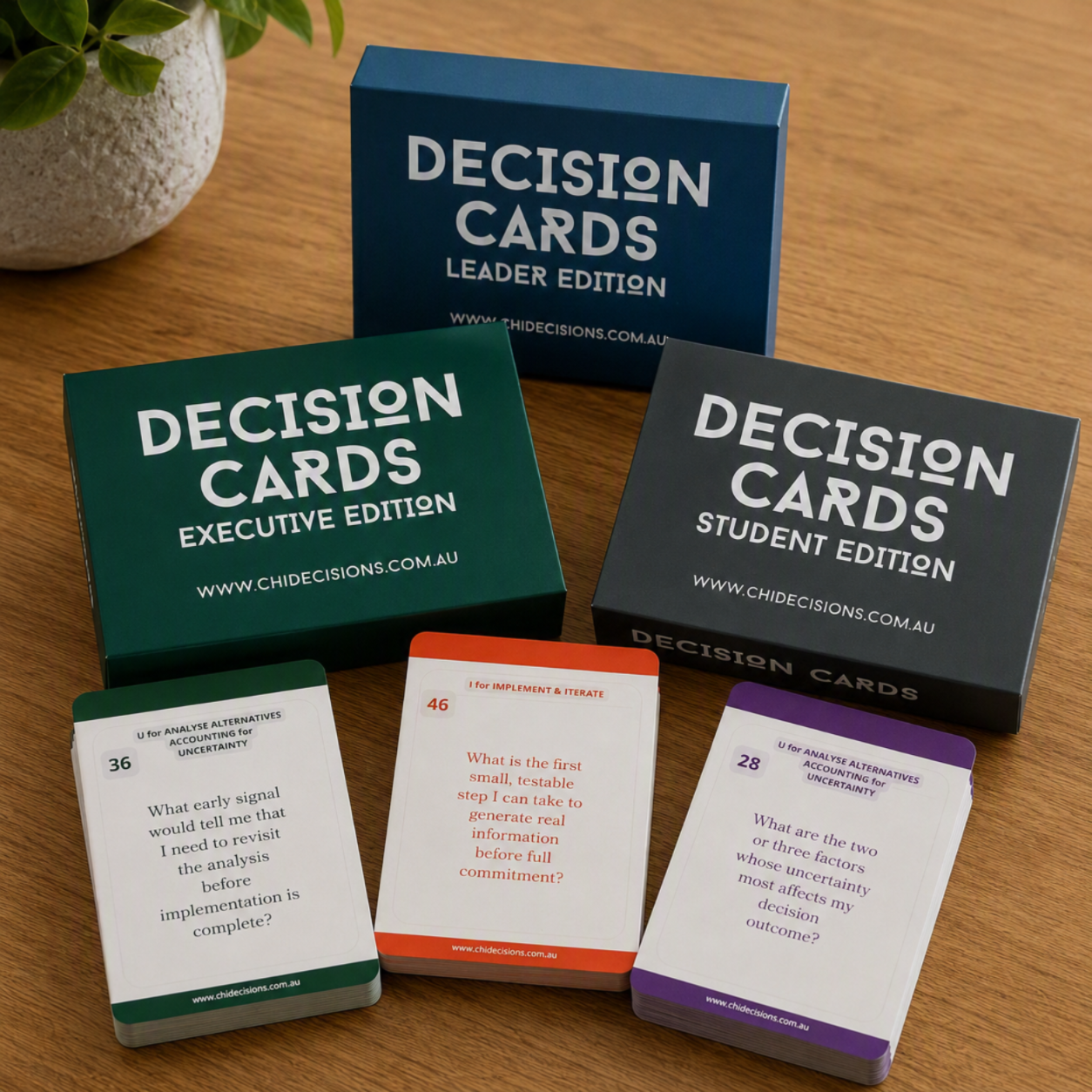
The executive team had spent weeks working through a major strategic decision. By the time they reached the meeting where the choice was to be made, everyone had a preferred option. The arguments were getting sharper, but nobody was really questioning the choice itself. One executive reached across the table and picked up a Decision Card. The question asked: “What would we advise another executive team facing a similar decision based on what we now know?”
The question changed the conversation. They stopped defending their own position and started looking at the decision as if they were advising someone else. They could see where hindsight was creeping into the discussion, what they had genuinely known at the time, and what they had simply learned afterwards. The card stayed on the executive's desk after the meeting.
That is what the Executive Edition is for. Not a box of questions that gets opened once, but a practical tool that finds its way into the room when an important decision needs another perspective. One question. One interruption. Sometimes that is enough to change the conversation. Bring the Executive Edition to your next leadership meeting here.
Leader Edition: The card that stopped the room
The leadership team had been discussing a major operational change for several weeks. The conversation kept coming back to the same two options. One was familiar and relatively easy to implement. The other was more ambitious, but carried more uncertainty. The team had analysed both carefully and was beginning to lean towards the safer choice.
One of the leaders picked up a Decision Card. The question asked: “Have I developed at least four genuinely different alternatives, including a ‘do nothing’ option?”
It was a simple question, but it exposed something the analysis hadn't. They had spent most of their time comparing the two options already on the table. Nobody had really stopped to ask whether there were other ways of achieving what they actually wanted. So they went back to the framing stage of the decision process. They revisited what they were actually trying to achieve and, from that frame, explored other ways forward. Two more possibilities emerged. One ultimately became the preferred option.
That is what the Leader Edition can become inside an organisation. A shared prompt that helps a team recognise when it needs to step back in the process, challenge its thinking and look at the decision differently. Bring the Leader Edition to your leadership team here.
Student Edition: The card that changed the choice
A Year 12 student was sitting with a decision that had started to feel bigger every day. University applications were getting closer; everyone had an opinion and there was one course that seemed like the sensible choice. Good career prospects. Good reputation. The sort of choice that was easy to explain to everyone else. The problem was that the student wasn't sure it was actually what they wanted.
They picked up the Student Edition deck and read a card: “Did I make up my mind before I thought it through, and am I now just looking for reasons to back it up?” It was an uncomfortable question. The student realised they had spent weeks looking for evidence that supported the choice they had already made, while quietly ignoring the things that made them uncertain. They went back and looked at the decision again, this time without trying to prove that their first answer was right. That card stayed on the desk.
And after that, they couldn't stop talking about it. They told their friends. They told their parents. They told anyone who would listen about the question that had made them stop and rethink something they thought they had already decided. That's what I love about the Student Edition. Sometimes one question is enough to make you see your own decision differently. Bring the Student Edition to your school, program or students here.
For more ways students are using the cards, follow us on our TikTok.
Guided Workbook: What happens when you start seeing your own bias?
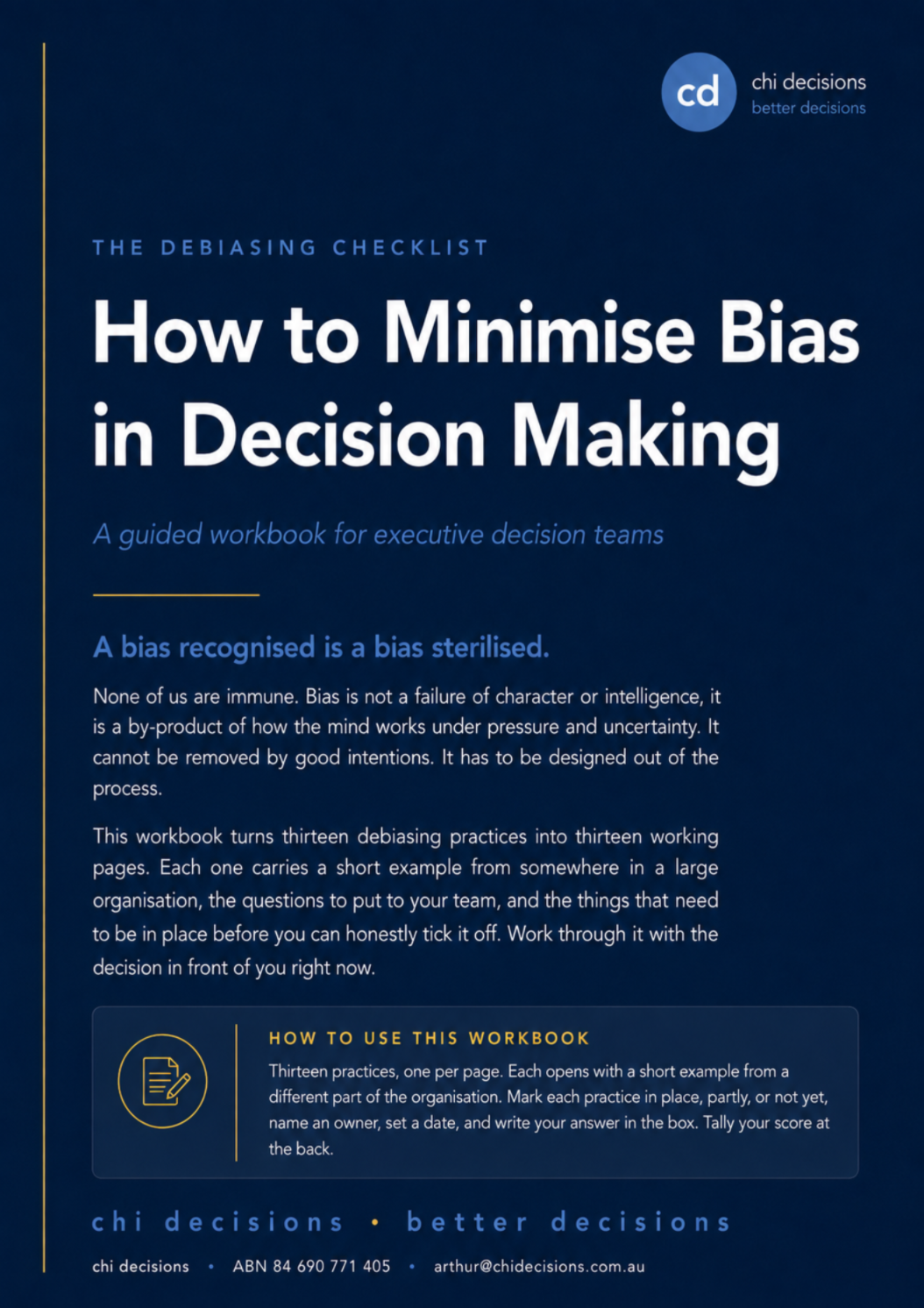
The value isn't having another document sitting on a hard drive. It's having a practical way to stop, examine how the decision is being made and deliberately put safeguards around the points where bias is most likely to enter. Over time, the leader starts recognising the patterns earlier. The team starts challenging them earlier. And the safeguards become part of how important decisions are made. That's the future I that this workbook can create - leaders who don't just know about bias but are better at spotting and managing it when it actually matters.
Take a look at the Guided Workbook here.
Building Decision Capability
To continue building practical capability across decision making, risk quantification and bias minimisation, we run the following sessions.
Quantifying Risks for Better Decision Making
7-hour workshop covering Monte Carlo simulation, risk quantification and presenting defensible results. $9,995 for minimum 5 participants, including GST. Book your workshop here.
How to Make a Good Decision: Applying the SABUDI™ Framework
7-hour practical workshop applying SABUDI™ to real-world decision making. $9,995 for minimum 5 participants, including GST. Book your workshop here.
Minimising Bias in Decision Making
5-hour workshop exploring cognitive and motivational bias and practical ways to minimise its impact. $9,495 for minimum 5 participants, including GST. Book your workshop here.
Keep Choosing Wisely
That is your lot for the month. Next time you reach for AI to help with an important decision, start with the work, not the technology. Ask what needs to be done, what AI can genuinely improve, and whether using it will make the decision better. Then choose wisely.
Cheers,
Arthur
P.S. Not yet subscribed? Make sure you don't miss future issues: Subscribe here. Access all our previous newsletters here: chi decisions Newsletters.